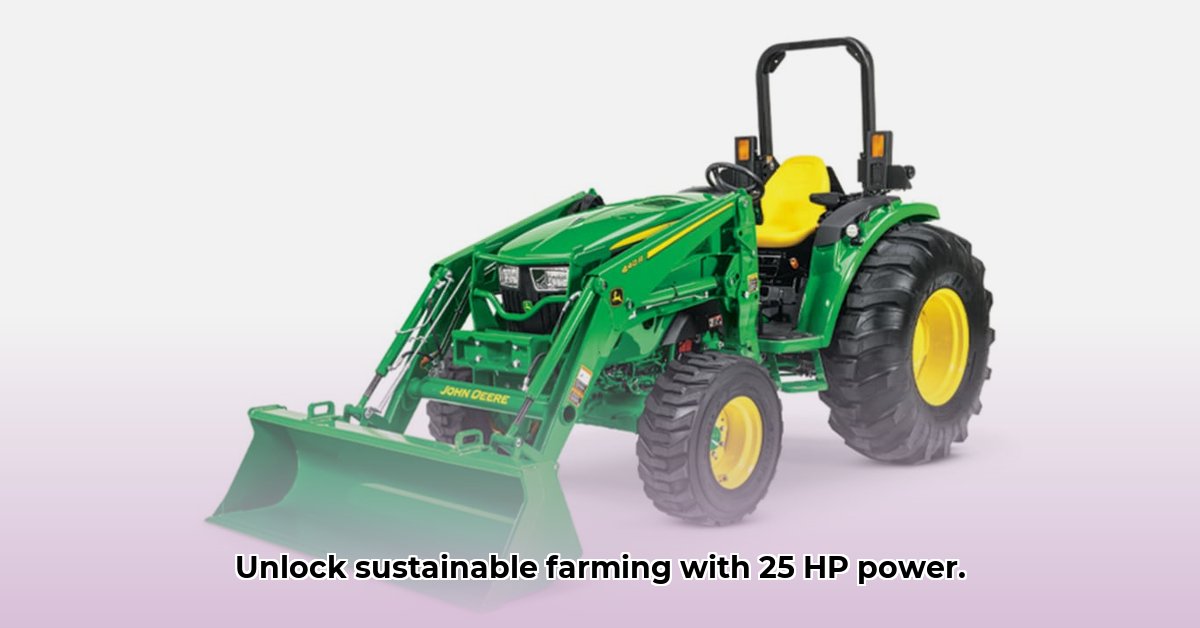
The John Deere 25 hp tractor, part of the 3 Series line, represents a compelling option for smaller farms and those prioritizing sustainable agricultural practices. Its compact size and versatility make it suitable for a range of tasks, but a complete assessment of its sustainability and economic viability requires further research. This article provides a technical overview, highlighting its strengths and limitations. For more information on other John Deere models, check out this helpful resource.
Technical Specifications & Features
The John Deere 25 hp tractor boasts a Yanmar diesel engine featuring Common Rail System (CRS) and an electronic control unit (ECU) for precise fuel management. This translates to improved fuel efficiency and reduced emissions. The 25 horsepower output is sufficient for various applications, from plowing and mowing to hauling and operating specialized attachments. Transmission options include hydrostatic (smooth, easy operation) and gear drive (greater control, heavier loads). The power take-off (PTO) system allows for connection of various implements, expanding its versatility. The hydraulic system's capacity directly affects the size and type of attachments that can be used. Stronger hydraulics provide greater operational flexibility.
Performance & Efficiency Analysis
While John Deere provides engine specifications, precise real-world data on fuel efficiency is limited. Fuel consumption varies drastically depending on factors like soil type, terrain, and the implemented tasks. For example, tilling rocky soil consumes significantly more fuel than mowing flat land. Comprehensive data on fuel consumption per acre for common farming tasks, along with maintenance and repair costs, are needed for an accurate assessment of operating costs. This information is critical for determining the tractor's long-term economic viability and its true environmental footprint.
Attachments & Implement Compatibility
The 25 hp tractor's compatibility with a wide range of implements is a significant advantage, particularly for sustainable farming. It can accommodate no-till drills, promoting soil health, and precision agriculture tools like GPS-guided spreaders, optimizing fertilizer use. However, individual implement compatibility should always be verified against the tractor's specifications.
Sustainability Considerations
A comprehensive lifecycle assessment (LCA) is necessary for a full evaluation of the tractor's environmental impact. While the CRS engine suggests reduced emissions, independent verification and a complete LCA, considering manufacturing, operation, and disposal, are needed. The tractor's potential for reduced environmental impact is amplified when used with sustainable farming techniques; however, the tractor's inherent sustainability is dependent on its operational usage.
Economic Viability
The initial purchase price, combined with fuel, maintenance, and repair costs, determines the overall economic viability. The return on investment (ROI) depends significantly on the tractor's application, the scale of operation, and the practices employed. Real-world data from farmers using the tractor for diverse sustainable farming operations are vital to accurately assess its economic performance and long-term ROI. Does the increased efficiency and reduced labor costs, particularly when practicing sustainable farming, outweigh the initial investment and ongoing operational costs? More data is crucial for a definitive answer.
Conclusion
The John Deere 25 hp tractor presents a promising option for sustainable agriculture, offering versatility and efficiency. However, a thorough evaluation of its long-term sustainability and economic viability hinges on further research and data collection. Areas needing further investigation include detailed fuel consumption data across varying conditions, a complete cost-of-ownership analysis, a comprehensive LCA, and real-world farmer feedback regarding operational efficiency and ROI in sustainable farming applications. These crucial data points will empower farmers and researchers to comprehensively evaluate the tractor's role in sustainable farming.